Boiler Not Heating or Losing Pressure? What It Means and When It Can't Wait
· By Ed Ferreira
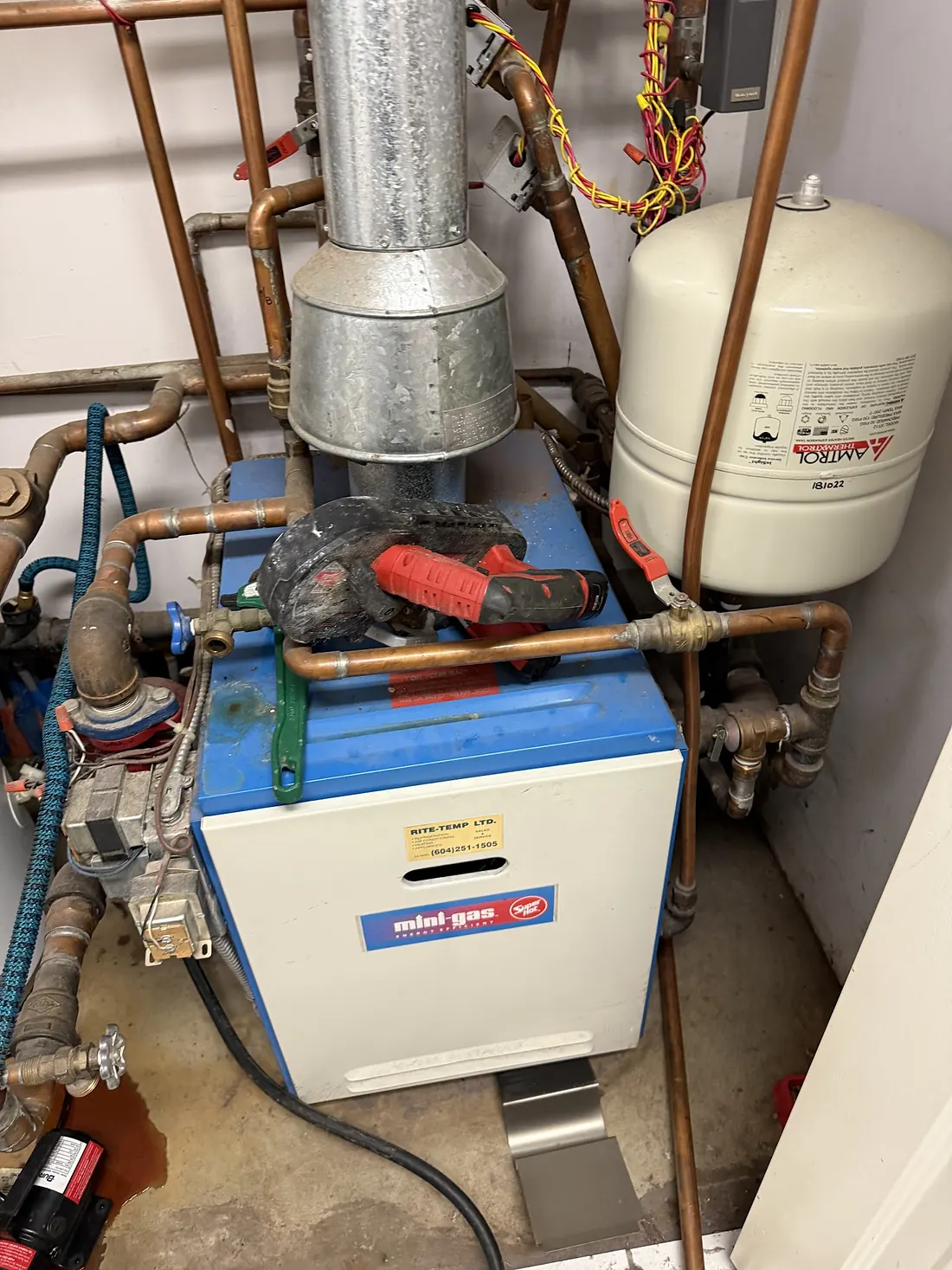
A hydronic boiler heats water and pushes it through pipes to radiators, baseboards or a radiant floor. When it stops, the house cools down fast, and on a wet January night in Richmond or Vancouver that gets uncomfortable within a few hours.
The good news: most boiler complaints fall into a short list of causes. Some you can rule out yourself in five minutes. Others need a trained technician, and a few need one today.
What a Struggling Boiler Looks and Sounds Like
The most obvious sign is no heat at all. Just as common is partial heat: one radiator stays cold while the rest are warm, a radiant floor feels lukewarm in one zone, or the house never quite reaches the thermostat setting. In townhouses with in-floor heating, a single cold bedroom is often the first clue.
Next, look at the pressure gauge on the front of the boiler or on the nearby piping. A needle that keeps drifting lower over days or weeks means water is leaving the sealed system somewhere. A needle climbing high while the boiler runs is a different problem and deserves a call.
Listen too. A rumbling or kettling sound, like water boiling in a pot, often points to scale or restricted flow through the heat exchanger. Gurgling usually means air in the pipes. Finally, many modern units show an error code or lock out and ask for a reset. Photograph the code before doing anything else.
Safe Checks You Can Do Before Calling
Confirm the thermostat is set to heat, the setpoint is above room temperature, and the batteries are not dead. Check that the boiler has power: look for a display or indicator light, and check the breaker panel and any service switch near the unit.
Read the pressure gauge with the system cold. As general guidance, many residential hydronic systems sit somewhere around 12 to 15 psi (roughly 1 to 1.5 bar) when cold, but your boiler label or manual is the real reference. If the reading is well below that, note it. Do not open fill valves or relief valves to adjust it unless the manual clearly says this is a homeowner task and you are comfortable doing it.
If one radiator is warm at the bottom and cold at the top, trapped air is the likely cause. Bleeding it is usually a reasonable homeowner job: turn the heating off and let things cool, hold a rag under the bleed valve, open it a quarter turn with a radiator key, and close it once water replaces the hissing air. Then recheck the gauge.
If your boiler shows an error and the manual allows a reset, one reset is fine. If the same code comes back, stop resetting. Repeated resets can hide a fault that is getting worse.
Signs Boiler Repair Cannot Wait
Some situations are not a next-week problem. If you smell gas, leave the house right away, do not flip switches or use anything that could spark, and call the FortisBC 24-hour emergency line at 1-800-663-9911 from outside. In BC, gas work is regulated by Technical Safety BC and must be done by a licensed gas fitter.
Treat these as same-day calls: water leaking from the boiler or piping, water discharging from the pressure relief valve, pressure climbing well above normal while the unit runs, scorch marks or soot around the burner area, or a carbon monoxide alarm going off. If a CO alarm sounds, get everyone outside first and call for help from there.
No heat during a cold snap also moves up the list. Metro Vancouver does not freeze often, but when temperatures drop below zero for a few days, pipes in crawl spaces and exterior walls become vulnerable, especially in older homes.
What a Proper Boiler Service Call Should Cover
A good technician does not just reset the unit and leave. Expect them to ask what you noticed and when, then check the error history, system pressure, the expansion tank, the circulator pump, zone valves and the controls. On gas units, they should check ignition, burner condition, venting and combustion safety.
If pressure is dropping, the job is to find where the water is going. Common culprits include a leaking fitting, a worn pump seal, a relief valve that weeps, a failed expansion tank, or a leak hidden in a wall or slab. Topping the system up without finding the leak just buys a little time.
Repair or Replace: How to Decide
Age is a starting point, not a verdict. Many residential boilers last somewhere in the range of 15 to 25 years, but water quality, maintenance history and how hard the system works all shift that number.
Repair usually makes sense when the boiler is mid-life, the fault is a single part such as a pump, sensor or valve, and the heat exchanger is sound. Replacement starts to make sense when the heat exchanger is cracked or leaking, breakdowns keep repeating, parts are hard to find, or the repair cost is a large share of a new unit. Facing a big repair on an aging boiler? Ask for both options in writing and compare.
Getting Your Boiler Ready Before Winter
The cheapest boiler repair is the one you never need. A yearly service in early fall, before the rainy season settles in, lets a technician catch worn parts, low pressure and combustion problems while the weather is still mild and scheduling is easy.
Between services, a few habits help. Glance at the pressure gauge once a month during the heating season and note any change. Bleed radiators that develop cold tops. Keep the area around the boiler clear and test your CO alarms.
If something looks off, Encano Plumbing and Drain can take a look. We are a family-owned team based in Richmond, and you can call or text (604) 764-2031 any hour for a free estimate, with one flat price in writing before work starts. We also speak Portuguese and Spanish.
Frequently asked questions
- Why is my boiler not heating but the pressure looks fine?
- If pressure is normal but there is no heat, the cause is often a thermostat or control issue, a failed circulator pump, a stuck zone valve, an ignition fault or air trapped in the system. Check the thermostat, power and any error code first. If those look right, a technician can test the pump, valves and controls to find where the heat is getting stuck.
- What should boiler pressure be when the system is cold?
- As a general guide, many residential hydronic boilers read somewhere around 12 to 15 psi, or roughly 1 to 1.5 bar, when cold. The right number for your home depends on the boiler and the height of the building, so check the label or manual. Pressure that keeps falling, or rises well above normal while running, should be looked at by a professional.
- Why does my boiler keep losing pressure?
- A sealed boiler system should hold pressure. If it keeps dropping, water is escaping somewhere: a leaking joint, radiator valve, pump seal or relief valve, a failing expansion tank, or a hidden leak in a wall or floor. Repeated losses need a proper leak check, not regular topping up.
- How long does a boiler last?
- Many residential boilers last somewhere between 15 and 25 years, though there is wide variation. Annual servicing, good water quality and correct sizing help a unit reach the upper end. Frequent breakdowns, a leaking heat exchanger or parts that are no longer available are common signs a boiler is near the end of its useful life.
- When is a boiler problem an emergency?
- Treat it as urgent if you smell gas, a carbon monoxide alarm sounds, water is leaking or spraying from the boiler or relief valve, or pressure climbs well above normal. For a gas smell, leave the house and call the FortisBC emergency line at 1-800-663-9911 from outside. No heat during freezing weather is also a same-day call.
- Is it safe to keep resetting my boiler?
- One reset, following the manual, is generally fine. If the same error comes back, stop. A boiler locks out because a safety control detected a problem such as failed ignition, poor circulation or overheating. Resetting again and again does not fix that cause and can let it get worse. Photograph the code and book a service visit.
Related services
Serving
Found this helpful? Make us a preferred source on Google.
Ready for an exact price?
Get a free, no-pressure in-home estimate. Real numbers for your home, not a phone guess.